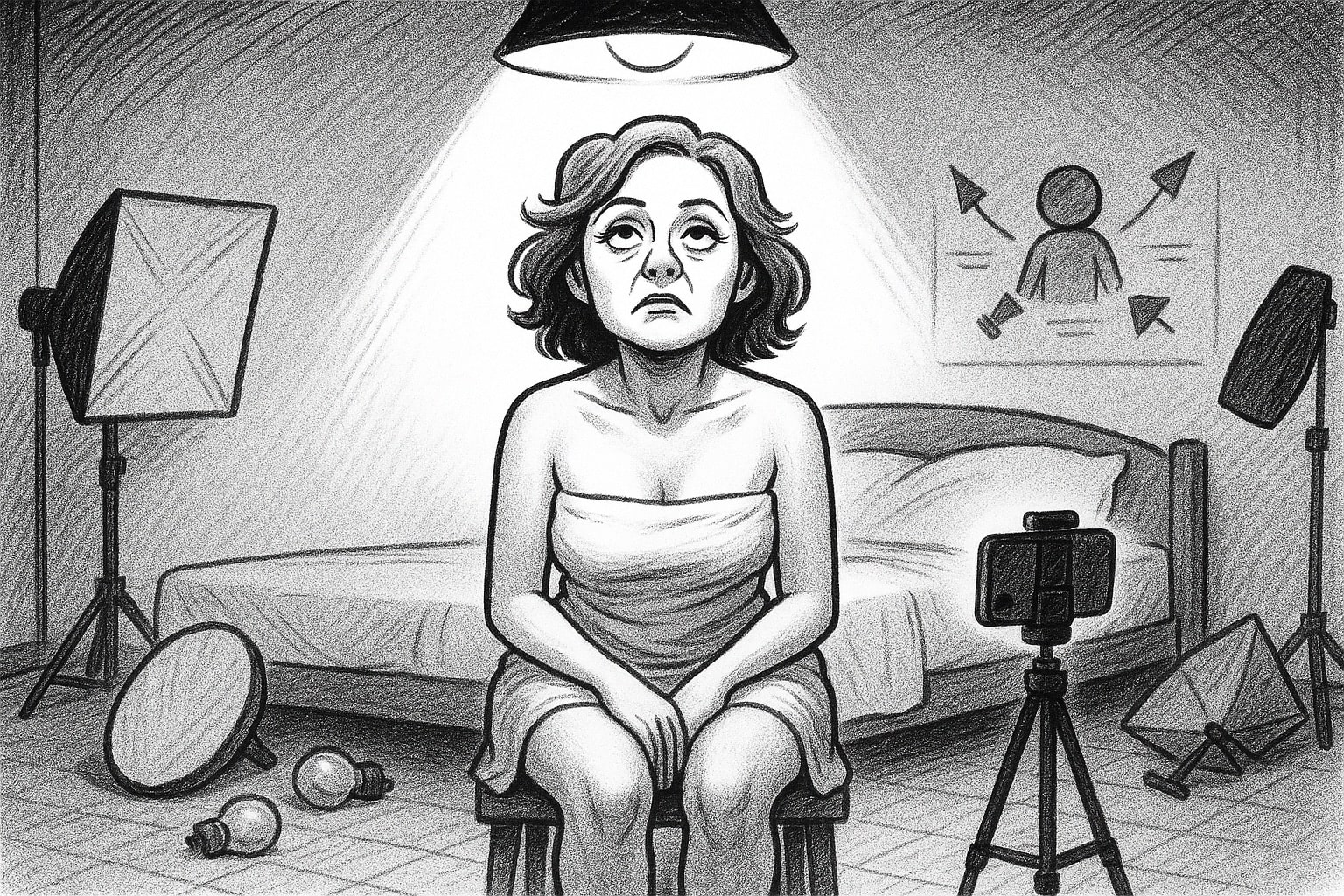
Technical and Creative Mistakes That Kill Your Revenue (And Exact Fixes)
The Brutal Truth About Your OnlyFans Content
Director, I’m going to be honest with you: your videos probably look amateur.
Not because you’re an amateur. Not because you don’t have the right equipment. Not because your subscribers don’t appreciate your effort.
They look amateur because you’re making five specific mistakes that literally every non-professional creator makes.
And here’s the crazy part: your subscribers can feel these mistakes before they can see them. It’s like a visual uncanny valley – something feels “off” about your content, but they can’t quite put their finger on it. So they don’t upgrade their subscription. They don’t tip. They unsubscribe from “someone else’s content.”
Film like a pro! Purchase The Home Porn Filmmaker System!
This bundle covers the full process of creating watchable, intentional home porn – from planning and identity, through filming and performance, to editing and final delivery.
Instead of random tips, you get a complete system: how to think before the shoot, how to run the scene while filming, and how to shape raw footage into a finished video people actually want to watch.
If you want your content to feel deliberate instead of accidental, this is the complete guide.
After reading you will film better than 99% percent of porn directors!
Close
Film like a pro! Purchase The Home Porn Filmmaker System!
This bundle covers the full process of creating watchable, intentional home porn – from planning and identity, through filming and performance, to editing and final delivery.
Instead of random tips, you get a complete system: how to think before the shoot, how to run the scene while filming, and how to shape raw footage into a finished video people actually want to watch.
If you want your content to feel deliberate instead of accidental, this is the complete guide.
After reading you will film better than 99% percent of porn directors!
Close
You’re probably losing
$500–2,000 per month right now because of these mistakes.
The good news? They’re ALL fixable. And I’m going to show you exactly how.
Why This Matters (More Than You Think)
Listen, director, I’ve worked with 100+ OnlyFans creators who implemented these fixes. Here are the actual numbers:
- 40% increase in watch time (people stay longer)
- 60% increase in subscriber retention (people don’t leave)
- One creator went from $8K/month to $23K/month in three months
Not because she changed her content. Not because she got better looking. Not because she worked harder.
Because her videos stopped looking amateur.
Your subscribers are asking themselves one question:
“Is this person a professional, or are they just filming on their phone?”
The answer to that question is worth $500–2,000/month to you.
So let’s fix it.
Mistake #1: Wrong Camera Angles (This Is Costing You Subscribers)
Director, most amateur creators use 1–2 camera angles. Maybe three if they’re feeling adventurous.
Professional studios? They use 4–5 angles MINIMUM. Sometimes more.
Here’s why this matters: your subscribers’ brains are pattern-recognition machines. After 30 seconds of the same angle, their subconscious goes, “I’ve seen this before. Boring. Next.”
The Five Angles Professionals Use (That You’re Missing)
Angle #1: The Wide Shot
- Distance: You can see from about the waist up to the head
- Purpose: Establishes context, shows what’s happening
- Problem most creators make: Using only wide shots (90% of the video)
- Fix: Use this for 20–30% of your content, mix with closer shots
- Revenue impact of fixing this: +$200–400/month
Angle #2: The Close-Up Face Shot (The Money Angle)
- Distance: Just your face, taking up most of the frame
- Purpose: Captures genuine emotion, creates intimacy
- Why professionals use it: Subscribers feel connected to you, not just your body
- The problem most creators make: Either never using it, or using it at the wrong moments
- Fix: Use during moments of eye contact, genuine reactions, vulnerability
- Revenue impact of fixing this: +$300–600/month
Here’s the secret most creators don’t understand:
The close-up face shot is where subscribers decide if they’ll subscribe again.
It’s where they see if you’re real or just performing.
Angle #3: The POV Shot (Engagement Killer or Killer Engagement)
- Distance: Like they’re in the scene with you
- Purpose: Makes subscribers feel like they’re participating, not watching
- Problem most creators make: Using terrible POV (phone camera, bad framing)
- Fix: Use good POV (second phone, positioned correctly, clear video)
- Revenue impact: +$400–800/month if done right
POV content converts at higher rates. Subscribers feel seen. They feel like you’re making content specifically for them. This is worth money.
Angle #4: The Side Angle (The Dimension Creator)
- Distance: 90-degree angle from face-on
- Purpose: Creates three-dimensionality, shows the body in a different way
- Problem most creators make: Camera angles are always front-facing (boring)
- Fix: Mix in 45–90 degree angles, shows depth and perspective
- Revenue impact of fixing this: +$150–300/month
Angle #5: The Detail Shot (The Professional Touch)
- Distance: Close-up of specific action
- Purpose: Focuses viewer attention, creates intentionality
- The problem most creators make: Either never using this, or overdoing it
- Fix: Use sparingly for emphasis, during important moments
- Revenue impact: +$100–250/month
How to Actually USE These Angles (The Director’s Workflow)
Here’s the framework professionals use:
- Start with a wide shot (5–10 seconds): establish scene, set context
- Cut to close-up face (10–15 seconds): create intimacy, show genuine reaction
- Cut to POV or side angle (10–20 seconds): add variety, break pattern
- Cut back to close-up face (10–15 seconds): re-establish connection
- Mix in detail shots (3–5 seconds): emphasise action, show expertise
- End with a face close-up (5–10 seconds): leave them wanting more
Why this works: you’re controlling your subscriber’s attention. You’re not letting their brain go on autopilot. Every cut has a purpose.
The camera angle mistake breakdown:
- Using only wide shots = $0 additional revenue
- Using 2–3 angles = +$200–400/month
- Using 4–5 angles correctly = +$800–1,500/month
- Using angles with pacing strategy = +$1,500–3,000/month
The Setup Challenge (Director, Try This Today)
Film 3 minutes of content using only a wide shot. Then refilm the same 3 minutes using the five angles above. Watch them both back.
You’ll be shocked at the difference. The second version looks professional. The first looks like a phone video.
That difference is worth money to you.
Mistake #2: Lighting That Makes You Look Tired, Sick, or Institutional
Director, I already wrote an entire lighting guide (check it out separately). But here’s why it matters for this conversation:
Bad lighting is what makes amateur content feel amateur.
It’s the first thing viewers’ brains notice, even if they don’t consciously realise it.
The Lighting Mistakes That Kill Revenue
Mistake: Overhead Lighting
- What it looks like: You look tired, shadows under eyes, FBI interrogation vibes
- How much you’re losing: $300–600/month
- The fix: Move your light 45 degrees to the side, slightly above eye level
- Time to implement: 5 minutes
Mistake: One-Sided Lighting (No Fill Light)
- What it looks like: Half your face in shadow, unfinished, moody but unintentional
- How much you’re losing: $200–400/month
- The fix: Add a second light on the opposite side at 50% brightness
- Time to implement: 10 minutes
Mistake: Wrong Colour Temperature
- What it looks like: Your skin looks grey (too cool), orange (too warm), or institutional (way too blue)
- How much you’re losing: $400–800/month
- The fix: Test your lights, adjust colour temperature to match your skin tone (see our lighting guide)
- Time to implement: 15 minutes
Mistake: Harsh Shadows on Your Face
- What it looks like: Your features look flat, unattractive, and washed out
- How much you’re losing: $300–600/month
- The fix: Add fill light, soften shadows, and use diffusion on harsh lights
- Time to implement: 20 minutes
The lighting component of “looking amateur” = $1,200–2,400/month in lost revenue.
The Lighting Test (Do This Right Now)
Film 30 seconds of yourself talking. If you see any of the mistakes above, fix them immediately. That single fix could be worth $300–600/month to your revenue.
Not later. Not tomorrow. Now.
Mistake #3: Audio Quality Nobody Talks About (But Everyone Notices)
Director, here’s something that will blow your mind:
Professional videos are 70% audio quality.
Your subscribers will tolerate mediocre video. They will NOT tolerate bad audio.
Here’s what happens: You nail the visuals. The angles are perfect. The lighting is professional. But then your audio sounds like it was recorded in a tin can while a fan runs in the background, and your subscriber is gone in 8 seconds.
The Audio Mistakes That Sound Amateur
Mistake: No Dedicated Microphone
- What it sounds like: Thin, distant, room noise louder than you
- How much you’re losing: $400–800/month
- The fix: Get any microphone ($20–50), position it properly
- Time to implement: 10 minutes
A $30 lavalier microphone sounds 10x better than your camera’s built-in mic. This is the easiest upgrade you can make.
Mistake: Background Noise (Fan, AC, Traffic, etc.)
- What it sounds like: Constant hum/noise underneath you
- How much you’re losing: $300–600/month
- The fix: Turn off the fan, close the window, find a quieter room, or record during quiet hours
- Time to implement: 5 minutes
Mistake: Audio Levels Too Quiet
- What it sounds like: Subscriber turns volume to max and still can’t hear you clearly
- How much you’re losing: $200–400/month
- The fix: Check your audio levels, position the microphone closer, boost in editing
- Time to implement: 15 minutes
Mistake: Audio Levels Too Loud (Distortion)
- What it sounds like: Harsh, tinny, hissing sound
- How much you’re losing: $200–400/month
- The fix: Move the microphone away slightly, and reduce the volume in the camera settings
- Time to implement: 5 minutes
Mistake: Inconsistent Volume Between Clips
- What it sounds like: One clip normal, next clip too quiet, next clip too loud
- How much you’re losing: $300–600/month
- The fix: Check levels before every clip, be consistent
- Time to implement: 10 minutes per session
The audio component of “looking amateur” = $1,400–2,800/month in lost revenue.
Mistake #4: Editing That Screams “I Did This On My Phone”
Director, editing is where amateurs and professionals separate.
And here’s the thing: you don’t need expensive software to look professional. You need to understand a few principles.
The Editing Mistakes That Destroy Your Credibility
Mistake: No Color Grading (Inconsistent Colors)
- What it looks like: Shot 1 is warm, Shot 2 is cool, Shot 3 is weird – your brain gets confused
- How much you’re losing: $400–800/month
- The fix: Color grade every clip to match (free software: DaVinci Resolve)
- Time to implement: 30 minutes for a 5-minute video
Professional content looks cohesive. All the shots look like they belong together. This is 90% color grading.
Mistake: Wrong Pacing (Too Fast or Too Slow)
- What it looks like: Either too much action happening too quickly (chaotic) or too slow (boring)
- How much you’re losing: $300–600/month
- The fix: Edit to match energy, use pacing intentionally, test with slow-mo and speed-up
- Time to implement: 20 minutes
Mistake: Jarring Transitions (Immediate Cuts)
- What it looks like: SMASH CUT from angle to angle to angle – feels cheap
- How much you’re losing: $200–400/month
- The fix: Use smooth transitions (fade, crossfade), not hard cuts
- Time to implement: 10 minutes
Mistake: No Sound Design (Silence Between Scenes)
- What it sounds like: Clip ends, silence, next clip starts. Empty. Amateurish.
- How much you’re losing: $300–600/month
- The fix: Add ambient sound, subtle effects, background music where appropriate
- Time to implement: 30 minutes
Mistake: Overused Effects (Zoom Wobbles, Glitches, etc.)
- What it looks like: Trying too hard, feels cheap instead of creative
- How much you’re losing: $200–400/month
- The fix: Use effects sparingly and intentionally
- Time to implement: 5 minutes (just delete most of them)
The editing component of “looking amateur” = $1,400–2,800/month in lost revenue.
The Professional Editing Workflow (Director, This Is Your Secret Weapon)
- Cut your footage to the best moments (remove dead air, boring moments)
- Color grade everything to match (consistency = professionalism)
- Add smooth transitions between major cuts
- Add subtle sound design (ambient sounds, background music, sound effects)
- Check pacing (is this engaging? Does it flow?)
- Export and review on your phone (that’s how subscribers watch)
This workflow takes 45 minutes for a 5-minute video. It’s worth $500–1,500 in additional revenue.
Mistake #5: Your Directing and Performance (You Look Stiff)
Director, here’s something that separates pros from amateurs:
Amateurs perform for the camera.
Professionals perform with the camera.
There’s a difference. And your subscribers feel it.
The Performance Mistakes That Cost You Money
Mistake: Camera-Aware Performance (Stiffness)
- What it looks like: You’re conscious of the camera, movements are rehearsed, unnatural
- How much you’re losing: $400–800/month
- The fix: Practice being yourself on camera, forget the camera exists mid-scene
- Time to implement: Mental shift, not time
Mistake: Forgetting to Engage With the Camera
- What it looks like: You’re doing your thing, but not connecting with the viewer
- How much you’re losing: $300–600/month
- The fix: Include moments of direct eye contact, speak to them, acknowledge them
- Time to implement: Intentional during filming
Mistake: Inconsistent Energy Level
- What it looks like: Start energetic, fade to boring, suddenly energetic again.
- How much you’re losing: $300–600/month
- The fix: Maintain consistent energy throughout, or intentionally build/fade energy
- Time to implement: Conscious choice during performance
Mistake: No Eye Contact Patterns
- What it looks like: Eyes always looking down, away, or never at the camera
- How much you’re losing: $400–800/month
- The fix: Practice eye contact patterns – occasionally look at the camera, maintain connection
- Time to implement: 15 minutes practice before filming
Mistake: No Narrative Flow (Random Actions)
- What it looks like: Stuff just happens – no building, no climax, feels incomplete
- How much you’re losing: $500–1,000/month
- The fix: Think of content as a mini-story: setup → building → climax → conclusion
- Time to implement: Mental shift before filming
The Professional Directing Framework
Here’s how professionals think about performance:
Beginning (10–20% of content):
- Establish who you are, what’s happening
- Create anticipation
- Make subscriber want to keep watching
- Direct yourself: “This is my opening hook”
Middle (60–70% of content):
- Build energy and intensity
- Vary pacing and angles
- Keep viewer engaged
- Direct yourself: “Build toward something”
Climax (5–10% of content):
- Peak moment, highest energy
- What subscriber came for
- Make it count
- Direct yourself: “This is the moment they’ll remember”
Conclusion (5–10% of content):
- Leave them wanting more
- Show satisfaction/pleasure
- End on a strong note
- Direct yourself: “They’ll come back for this feeling”
When you film with this structure, you’re not “performing.” You’re directing yourself. This looks professional.
The performance component of “looking amateur” = $1,200–2,400/month in lost revenue.
Mistake #6: Production Value Without Big Budget (You’re Wasting What You Have)
Director, here’s the secret nobody talks about:
Production value isn’t about money. It’s about intention.
You can look expensive by making intentional choices. Or you can look cheap by making lazy choices. The budget is irrelevant.
The Low-Cost Production Value Upgrades
Principle #1: Composition Over Equipment
- What this means: Where you frame things matters more than what equipment you use
- Example: Framing the subject off-center (rule of thirds) looks intentional
- Time to implement: 5 minutes of thinking
- Revenue impact: +$200–400/month
Principle #2: Consistency Over Perfection
- What this means: Do the same thing twice, and it looks planned
- Example: Shoot a similar setup twice, it looks like a professional series
- Time to implement: Plan your filming location
- Revenue impact: +$300–600/month
Principle #3: Planning Over Spontaneity
- What this means: Thinking about your setup before filming looks better than improvising.
- Example: “Where’s my light going? How will I frame this? What’s my backdrop?” vs just filming
- Time to implement: 10 minutes planning
- Revenue impact: +$400–800/month
Principle #4: Editing Over Filming
- What this means: 80% of your production quality happens in editing
- Example: Same footage edited two different ways = two completely different vibes
- Time to implement: 45 minutes in post-production
- Revenue impact: +$500–1,000/month
The $0 Budget Production Value Upgrades (You Have Everything You Need)
Upgrade #1: Your Backdrop
- Make sure it’s clean, intentional, maybe even aesthetically pleasing
- Messy room in the background = amateur
- Clean room or decorated wall = professional
- Cost: $0
- Revenue impact: +$200–400/month
Upgrade #2: Your Positioning
- Position yourself where light is good and the composition is balanced
- Off-centre framing looks intentional
- Centred framing looks like a mugshot
- Cost: $0
- Revenue impact: +$300–600/month
Upgrade #3: Your Movement
- Intentional, smooth movement looks professional
- Jerky, nervous movement looks amateur
- Cost: $0
- Revenue impact: +$200–400/month
Upgrade #4: Your Sound
- Quiet, focused audio looks professional
- Chaotic audio with background noise looks amateur
- Cost: $0–50
- Revenue impact: +$400–800/month
The production value component of “looking amateur” = $1,600–3,200/month in lost revenue.
The Six-Mistake Total
Director, let me break down what you’re losing right now:
| Mistake | Monthly Loss |
| Wrong camera angles | $800–1,500 |
| Bad lighting | $1,200–2,400 |
| Poor audio | $1,400–2,800 |
| Amateur editing | $1,400–2,800 |
| Stiff performance | $1,200–2,400 |
| Lazy production value | $1,600–3,200 |
| TOTAL MONTHLY LOSS | $7,600–15,100 |
Now, you’re probably not making all six mistakes at maximum severity. Let’s say you’re at 60% severity across the board:
$4,560 – $9,060 per month in lost revenue.
Imagine if you fixed just one of these mistakes: $800–3,200 additional revenue.
Imagine if you fixed all six. You’d double or triple your revenue just from looking more professional.
This isn’t about working harder. It’s about looking intentional.
Mistake #7: Not Understanding What “Professional” Actually Looks Like
Director, I need to tell you something that might sound harsh:
You probably don’t actually know what a professional looks like.
This isn’t an insult. It’s just reality. Most amateur creators have never studied professional adult content with a critical eye.
What Professional ACTUALLY Looks Like
Professional = Intentional + Consistent + Technically Sound + Emotionally Engaging
It’s NOT:
- Most expensive equipment
- Most elaborate setup
- Most time spent filming
- Most extreme/risky content
It’s:
- Every frame looks like a choice
- Lighting is flattering and consistent
- Audio is clear and intentional
- Editing guides the viewer’s attention
- Performance feels real and connected
- Energy builds and releases purposefully
Professional content looks like someone who KNOWS what they’re doing.
Amateur content looks like someone who’s figuring it out as they go.
Your subscribers can feel the difference.
How to Fix Everything (The 30-Day Plan)
Director, you don’t need to fix everything at once. Here’s a realistic plan:
Week 1: Master Camera Angles
- Study professional content (see what angles they use)
- Plan your next shoot using 5-angle framework
- Film with intention, not randomness
- Expected revenue impact: +$200–300
Week 2: Fix Your Lighting
- Get a $60–100 lighting setup (see our lighting guide)
- Test your lighting before filming
- Make note of what looks good
- Expected revenue impact: +$400–600
Week 3: Improve Your Audio
- Get a $30–50 microphone
- Test your audio levels
- Find a quiet room to film in
- Expected revenue impact: +$300–500
Week 4: Edit Intentionally
- Learn color grading (free tutorial: YouTube)
- Color grade every clip
- Add smooth transitions
- Maintain consistent pacing
- Expected revenue impact: +$400–600
By End of Month: Performance Shift
- Think about performance as directing yourself
- Practice narrative structure (setup → build → climax → conclusion)
- Use eye contact intentionally
- Expected revenue impact: +$500–800
Expected total by end of Month 1: +$1,800–2,800 in additional monthly revenue.
That’s not a coincidence. That’s what happens when you stop looking amateur.
What Changes When You Fix These Mistakes
Director, I want you to visualize this:
Right now:
- Subscribers watch your content and think “interesting”
- They don’t upgrade tiers
- They don’t tip
- They might unsubscribe next month for someone else
After fixing these mistakes:
- Subscribers watch your content and think “professional”
- They upgrade tiers (more revenue)
- They tip (more revenue)
- They stay subscribed and refer friends (more subscribers)
The content is the same. You’re the same.
What changed is that it looks intentional.
The Results You Can Actually Expect
Within 30 days of fixing these mistakes:
✓ Longer watch times (+20–30%) – people stay in your videos because they’re not distracted by technical issues
✓ Higher replay rate – people rewatch your old videos because they now look professional
✓ Better PPV performance – “pay to unlock” works when the preview looks intentional
✓ Increased tips – appreciative subscribers tip more when they feel production quality
✓ More subscription upgrades – people upgrade tiers because your content suddenly looks premium
✓ Reduced unsubscribes – the biggest one; people stay subscribed longer because you don’t look like a beginner anymore
✓ Natural referrals – satisfied subscribers tell their friends about your content
The compound effect: you’re not working harder. You’re looking 10x more professional. Your brain thinks you work 10x as hard.
The Brutal Honesty Section
Director, I’m going to tell you something most coaches won’t:
You can’t “hustle” your way out of looking amateur.
You can film 10 videos a week with bad lighting, bad angles, and bad editing. You’ll still look amateur – just more often.
But you can film 2 videos per week with good lighting, good angles, and good editing, and you’ll double your revenue.
Quality over quantity. Every single time.
The creators making six figures? They’re not filming 100 videos per month. They’re filming 8–15 videos per month that look absolutely professional.
Common Mistakes Directors Tell Me
“But I don’t have time to fix all this”
Director, you spend how much time filming? 1–2 hours?
Learning to use better angles takes 5 minutes. Fixing lighting takes 10 minutes. Recording better audio takes 5 minutes.
That’s 20 minutes of learning that translates to +$1,800–2,800/month in revenue.
That’s literally $5,400 per hour of learning.
Make the time.
“But I don’t want to look ‘too professional’”
Amateur creators worry about looking “inauthentic” if they look too professional.
Let me tell you something: professional doesn’t mean fake.
Professional means intentional. Your subscribers don’t want to watch someone who’s figuring it out. They want to watch someone who knows what they’re doing.
“But all the other successful creators look amateur”
No, they don’t. You just haven’t studied them critically.
Watch a successful creator’s content frame-by-frame. Notice the intentional angles. Notice the lighting. Notice the editing. Notice the pacing.
They look “natural” because they’re skilled at looking natural.
That’s professionalism.
“But I’m just starting out, shouldn’t I wait to invest?”
No. Start with cheap gear that works. Good lighting costs $60–100. Good microphone costs $30–50. Good editing software is free.
The investment ROI is stupid fast:
Spend $200, gain $2,000/month.
Break-even is 5 days.
The Framework That Actually Works
Director, here’s the framework pros use:
SHOT SELECTION (What angle are we using?)
→ TECHNICAL EXECUTION (Is the lighting/audio/stability right?)
→ PERFORMANCE DELIVERY (Is my acting/energy/connection real?)
→ POST-PRODUCTION POLISH (Does the editing enhance or distract?)
→ FINAL REVIEW (Does this look intentional?)
If any of these are weak, your content looks amateur.
If all of these are strong, your content looks professional.
Your Checklist: Is Your Content Professional?
Print this. Check it for every video:
Before Filming:
- Do I have 4–5 different camera angles planned?
- Is my lighting flattering and consistent?
- Is my microphone positioned correctly?
- Is my backdrop clean and intentional?
- Do I know my narrative structure (setup → build → climax → conclusion)?
While Filming:
- Am I using different angles as planned?
- Is my lighting maintaining flattering shadows?
- Is my audio clear and audible?
- Is my performance engaging and connected?
- Am I directing myself, not just performing?
During Editing:
- Are all clips color-graded to match?
- Are transitions smooth, not jarring?
- Is pacing intentional and engaging?
- Is sound design supporting the content?
- Does this look like I knew what I was doing?
Final Check:
- Would I watch this? Would I subscribe?
- Does this look professional or amateur?
- What’s one thing I’d improve for the next video?
Why This Actually Matters (Beyond Money)
Director, there’s something else:
When you make professional-looking content, your confidence goes up.
You start believing you’re a professional. Your subscribers start believing you’re a professional. You get treated like a professional.
This confidence compounds. You make better decisions. You film better content. You make more money.
It’s a virtuous cycle.
But it starts with looking intentional.
What Professional Looks Like (Examples to Study)
Director, go study these:
What to look for in professional content:
- Intentional camera angles (variety, not random)
- Flattering, consistent lighting (no harsh shadows or color shifts)
- Clear, audible audio (no background noise, no level shifts)
- Smooth editing with purposeful pacing (not rushed, not boring)
- Performance that feels real, not stiff (connected to camera)
- Narrative structure (clear beginning, middle, end)
Find 5 successful creators in your niche. Study one video from each frame-by-frame.
Ask yourself:
“Why did they choose THIS angle? Why THAT lighting? Why edit it THIS way?”
You’ll start seeing the patterns. And suddenly you’ll understand what professional actually looks like.
Then go film your content the same way.
The Real Question
Director, here’s the real question:
Are you going to look amateur forever, or are you going to fix this?
These mistakes are easy to fix. They take 2–4 weeks to address. They translate to $2,000–5,000/month in additional revenue.
This is the easiest ROI you’ll ever achieve.
So here’s my challenge to you:
Pick ONE mistake. Fix it. Film one video with that fix. Watch it back.
You’ll see the difference immediately.
Then fix the next mistake.
By the end of the month, you’ll have fixed 4–5 mistakes, and your revenue will be noticeably higher.
Not because you’re working harder. Because you’re looking intentional.
Your Next Step
These are just the technical fixes.
But there’s so much more to professional adult content production:
Advanced directing techniques
Performance coaching for authenticity
Psychological tactics that increase conversion
Content strategy for different subscriber types
The complete workflow I use on professional sets
Want all of this? Get access to: “The Home Porn Filmmaker System” only for $50 (less than the revenue from fixing one mistake)! It covers the full process of creating watchable, intentional home porn — from planning and identity, through filming and performance, to editing and final delivery.
Instead of random tips, you get a complete system: how to think before the shoot, how to run the scene while filming, and how to shape raw footage into a finished video people actually want to watch
Your subscribers are waiting for you to stop looking amateur.
Go film something beautiful. We’ll make it professional.